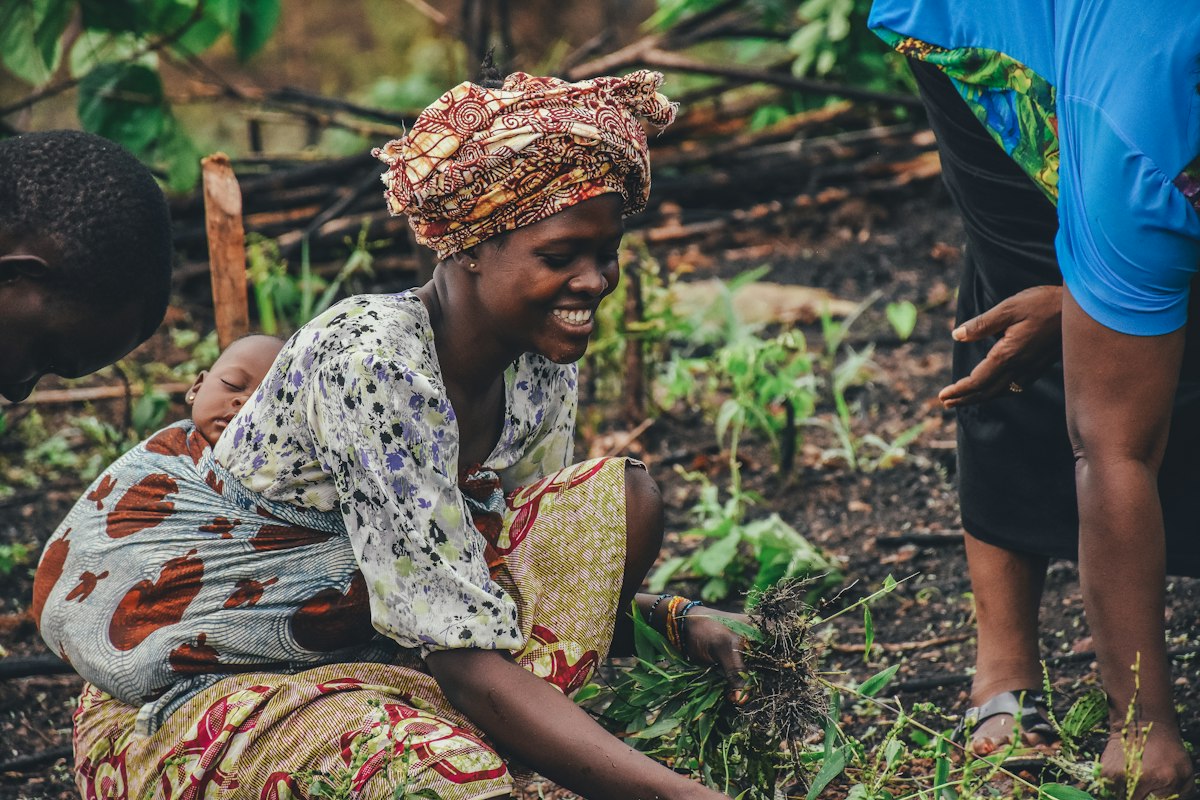
Africa is the world's youngest continent. More than three in five people on the continent are under the age of 25. Sub-Saharan Africa's youth population is projected to grow by 65% by 2050, and an estimated 440 million young Africans will enter the labour market by 2030, a wave of human energy and potential that has no precedent in the continent's history (African Development Bank [AfDB], 2024).
Africa is also a continent where agriculture employs 60% of the workforce and contributes 35% of GDP in the West and Central Africa sub-region (AfDB, 2024). It is a continent where 65% of the world's uncultivated arable land lies waiting (African Union, 2014). It is, in theory, the world's greatest agricultural frontier.
And yet Africa's agricultural sector is dominated by an aging, smallholder farming population, and youth are leaving it in large numbers. This is the African agricultural paradox, and it is one of the most consequential development challenges of the 21st century.
The Youth Bulge: Dividend or Disaster?
Africa's rapidly growing youth population is often described as a demographic dividend: a potential economic boom driven by a large, young, working-age population. But a dividend only materialises when young people can access productive, dignified employment. Without that, the same demographic surge becomes a demographic risk, with millions of educated, ambitious, and unemployed young people in economies that cannot absorb them.
An estimated 20 million young Africans enter the labour market every year, while Africa currently creates only about 3 million formal jobs annually (AfDB, 2024). That gap, 17 million young people per year, does not go away. It accumulates in informal employment, in migration, in social instability, and in the persistent underutilisation of Africa's most abundant resource: its young people.
What the Research Shows
A 2024 review published in the South African Journal of Agricultural Extension found that African youth participation in agriculture is viewed as a challenge across virtually every country studied. Young Africans have largely pessimistic perceptions about agriculture's ability to improve their living standards, and existing agricultural interventions are predominantly production-centric, offering low income and inadequate social protection (Chikwanda et al., 2024).
A scoping review of studies from 2009 to 2019 across African countries confirmed that youth face multiple compounding barriers: land access that systematically excludes those without inheritance, financial exclusion by risk-averse banks, skills gaps, and near-total invisibility in agricultural policy processes (Biovision Africa Trust, 2023).
Gender Makes It Harder
Young women face compound disadvantages. They own less land, access less credit, and carry a disproportionate burden of unpaid household labour. Research by IFAD and CGIAR has consistently found that female youth engagement in agribusiness faces additional structural barriers that go beyond the challenges facing young men (IFAD, 2019). Addressing gender inequality in agricultural access is not simply a matter of equity. It is a matter of economic necessity. Africa cannot unlock its agricultural potential while excluding half its young people from meaningful participation.
The Policy Promise and the Implementation Gap
Africa's leaders have made bold commitments. The African Union's 2014 Malabo Declaration committed member states to halving poverty by 2025 and creating agricultural jobs for at least 30% of youth (African Union, 2014). The Kigali Youth Declaration on Food Systems, Policy and Climate Action (2024), which consulted youth from 28 African countries including Ghana, reaffirmed that African youth hold the greatest potential to transform the continent's food systems (African Union Development Agency, 2024).
But the gap between policy language and lived reality remains large. The informal sector continues to absorb African youth in precarious, unprotected conditions. Agricultural investments prioritise large-scale commercial farming over smallholder modernisation. Youth are consulted in declarations but excluded from decisions.
The Market the Paradox Conceals
The African Development Bank has estimated that fulfilling the potential of African agribusiness could open markets worth more than USD 100 billion per year (AfDB, 2024). Africa has 65% of the world's uncultivated arable land (African Union, 2014). The continent's growing middle class is creating expanding demand for processed, packaged, and traceable food products. The continental free trade infrastructure provided by AfCFTA is creating access to a market of 1.7 billion people.
The gap between Africa's agricultural potential and its current reality is not a resource problem. It is a people, skills, and systems problem. And that means it is also a solvable problem, if the right investments are made, in the right places, for the right people.
Ghana in the African Context
Ghana sits at the centre of the West and Central Africa sub-region, one of the world's youngest and most agriculturally significant regions. Its youth unemployment crisis, its aging farmer population, and its massive food import dependency all mirror the continental challenge at a national scale. But Ghana also has stable institutions, growing digital infrastructure, a strategic position as the AfCFTA Secretariat host, and a growing ecosystem of organisations committed to building the next generation of agripreneurs.
The paradox of Africa's youngest continent having its oldest farmers is real. But paradoxes can be resolved. The resolution here requires investment in youth, and it requires it now.
References
- African Development Bank. (2024). African economic outlook 2024: Driving Africa's transformation. African Development Bank Group.
- African Union. (2014). Malabo declaration on accelerated agricultural growth and transformation for shared prosperity and improved livelihoods. African Union.
- African Union Development Agency. (2024). Kigali youth declaration on food systems, policy and climate action. AUDA-NEPAD.
- Biovision Africa Trust. (2023). Youth and agribusiness in Africa: Analysis of opportunities and barriers. Biovision Africa Trust.
- Chikwanda, D., Mwale, M., & Tembo, G. (2024). Youth engagement in agriculture in sub-Saharan Africa: A systematic review. South African Journal of Agricultural Extension, 52(1), 1–18. https://doi.org/10.17159/2413-3221/2024/v52n1a15811
- International Fund for Agricultural Development. (2019). Creating opportunities for rural youth. IFAD. https://doi.org/10.18356/d8c2b85e-en
- International Labour Organization. (2023). World employment and social outlook: Trends 2023. International Labour Office.