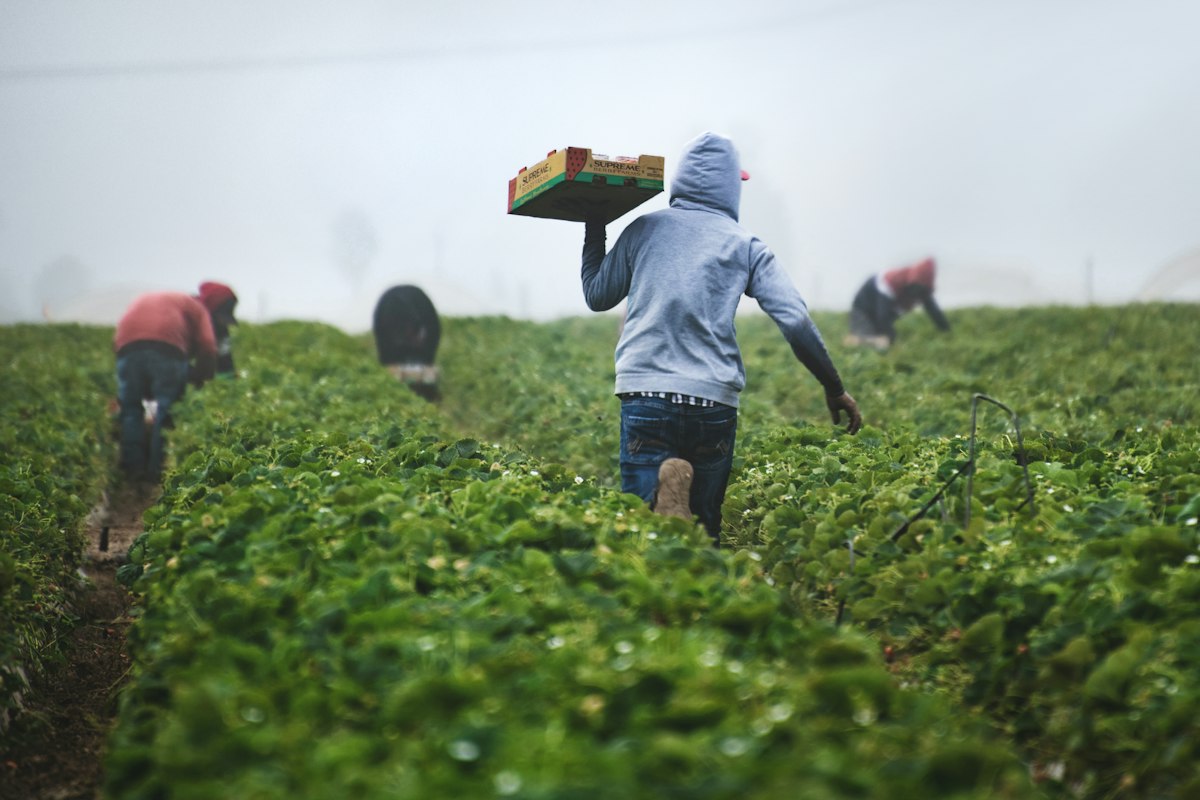
Walk into any farm in the United States, Japan, or Western Europe, and you will likely meet someone who could be your grandparent. The average farmer in the United States is 58.1 years old (United States Department of Agriculture [USDA], 2022). In Japan, that figure climbs to 67 (Ministry of Agriculture, Forestry and Fisheries [MAFF], 2023). Across the European Union, only 5.6% of all farms are managed by someone under the age of 35, while more than 31% are led by someone over 65 (Eurostat, 2023).
These are not coincidences. They are the symptoms of what researchers have begun calling the young farmer problem: a structural crisis in which agriculture's workforce is aging faster than it is being replenished, and where the next generation has largely decided that farming is not for them.
A Workforce Growing Old
The scale of the shift is striking. Agriculture's share of global employment has fallen from approximately 44% in the early 1990s to just 26% in 2023, based on modelled estimates drawing on International Labour Organization data (World Bank, 2023). As economies develop and urbanise, fewer people farm. That much is expected. What is not expected, and not sustainable, is that the people still farming are overwhelmingly approaching the end of their working lives, with no clear generation behind them.
In the United States, the 2022 Census of Agriculture recorded more than 40% of all farm operators as aged 65 or older (USDA, 2022). The National Young Farmers Coalition (2023) has described this as a generational emergency for American food production. In Japan, where the average farmer is 67 and agricultural productivity is already under strain, the government has designated youth agriculture as a national strategic priority (MAFF, 2023). In the European Union, less than one in twenty farms is run by someone under 35 (Eurostat, 2023).
What These Numbers Actually Mean
When we talk about aging farmers, we are not simply describing a demographic curiosity. We are describing a succession crisis. Farms require knowledge that takes decades to accumulate: knowledge of soil, seasons, markets, machinery, and relationships. When a farmer retires without passing that knowledge on, it does not simply transfer to the next person. Often, it disappears entirely.
The consequences are already visible. In many high-income countries, farm consolidation is accelerating as older farmers sell to corporate agribusinesses rather than to young successors. In developing economies, the problem takes a different form: smallholder plots go underutilised, yields stagnate, and rural communities hollow out as young people leave for cities.
The Urbanisation Acceleration
Urbanisation is both a cause and a consequence of the young farmer problem. Cities now house 45% of the global population, more than double the share in 1950, and the United Nations projects that two-thirds of humanity will live in urban areas by 2050, with the fastest growth occurring in Africa and Asia (United Nations Department of Economic and Social Affairs [UN DESA], 2022). When young people migrate from rural areas to cities, they are making rational economic choices given the options available to them. Agriculture, as currently structured in most countries, cannot compete with the perceived opportunities of urban life in income, status, lifestyle, or security.
But here is the paradox: the world needs to produce significantly more food over the next three decades to feed a growing global population, yet the people who know how to produce that food are retiring, and the people who could replace them have largely chosen not to.
The FAO's Warning
The Food and Agriculture Organization of the United Nations has documented this crisis with increasing urgency. Its 2024 report on the status of youth in agrifood systems found that while 44% of working youth globally still rely on agrifood systems for employment, that share has fallen sharply from 54% in 2005, a loss of 10 percentage points in just 16 years representing tens of millions of young workers who left or chose not to enter agriculture (Food and Agriculture Organization [FAO], 2024).
"Eliminating youth unemployment and bringing NEET youth aged 20 to 24 into productive employment could boost global GDP by 1.4%, equivalent to USD 1.5 trillion, with approximately 45% of that increase coming from agrifood systems alone" (FAO, 2024, p. 12).
The economic case for solving the young farmer problem is not just compelling. According to the FAO (2024), it is transformational.
The Stakes for Ghana
While the aging farmer phenomenon is a global challenge, its implications are sharpest in sub-Saharan Africa and specifically in Ghana. Africa is simultaneously the world's youngest continent, with more than three in five people under 25, and home to some of the world's oldest agricultural workforces. In Ghana, the average farmer is 55 years old, with a national life expectancy of approximately 60 (Ghana Statistical Service [GSS], 2021). The mathematics of that situation are sobering.
This is why youth agribusiness is not a trend or a buzzword in the Ghanaian context. It is an urgent national priority and a genuine opportunity for the generation that chooses to claim it.
The Opportunity Inside the Crisis
The young farmer problem is real. But it is also, for those who see it clearly, one of the greatest entrepreneurial opportunities of the 21st century. Land, markets, and institutional demand are all available in contexts where the incumbent generation is retiring. Technologies that older farmers have been slow to adopt, such as precision agriculture, mobile market platforms, and digital credit, give young entrants an immediate competitive edge. And the demand for food is not declining.
The question is not whether young people will eventually enter agriculture. They will have to. The question is whether we build the conditions in policy, financing, training, and culture that allow them to do so on terms that are dignified, profitable, and inspiring. That work begins with understanding the scale of the challenge we face.
References
- Eurostat. (2023). Farm structure statistics. European Commission. https://ec.europa.eu/eurostat/statistics-explained/index.php/Farm_structure_statistics
- Food and Agriculture Organization of the United Nations. (2024). Status of youth in agrifood systems 2024. FAO. https://doi.org/10.4060/cd1866en
- Ghana Statistical Service. (2021). Ghana 2021 Population and Housing Census: General report volume 3A. GSS.
- Ministry of Agriculture, Forestry and Fisheries. (2023). Agricultural census 2020: Summary of results. Ministry of Agriculture, Forestry and Fisheries, Japan.
- National Young Farmers Coalition. (2023). Building a future with farmers II: Challenges and opportunities facing the next generation of American farmers. NYFC.
- United Nations Department of Economic and Social Affairs. (2022). World urbanization prospects: The 2022 revision. United Nations. https://doi.org/10.18356/9789210014984
- United States Department of Agriculture, National Agricultural Statistics Service. (2022). 2022 Census of Agriculture: United States summary and state data. USDA-NASS.
- World Bank. (2023). Employment in agriculture (% of total employment). World Development Indicators. https://data.worldbank.org/indicator/SL.AGR.EMPL.ZS