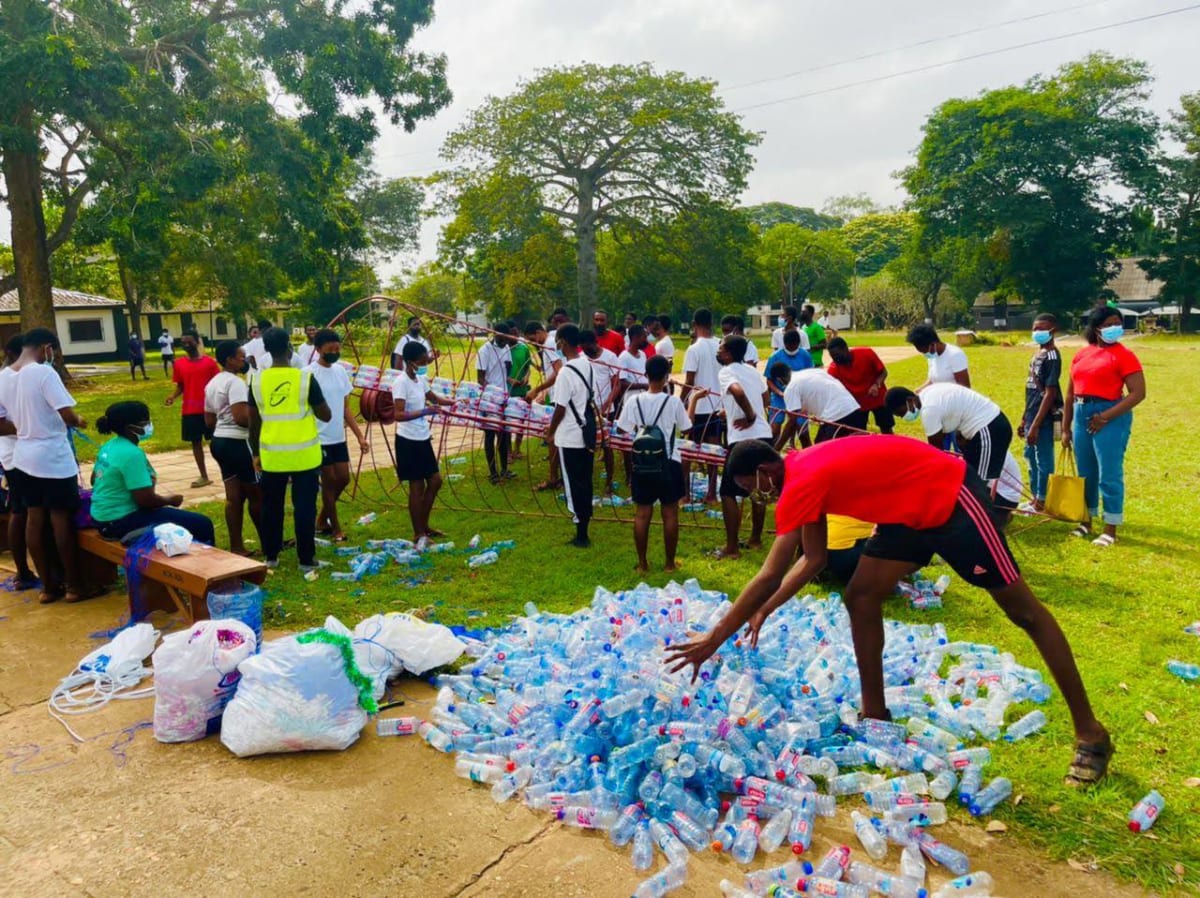
Every day, Ghana’s towns and cities generate mountains of waste — plastic bottles, food scraps, packaging, worn-out electronics, textiles. Much of it is never collected. Of what is collected, only a small fraction is recycled. The rest ends up in landfills, gutters, and open drains, or is burned in the open air.
We tend to see this as a sanitation problem. It is. But it is also something else: an enormous, daily loss of value. The plastic clogging a drain in Accra is not just litter — it is raw material that could have been a fence post, a paving block, or a new product. That is the insight at the heart of the circular economy, and it is one of SWK Ghana’s core focus areas.
What Is the Circular Economy?
The economy most of us grew up with is linear: we take resources, make products, use them, and throw them away. Take, make, waste. It assumes resources are unlimited and that “away” is a real place. Neither is true.
A circular economy is designed to eliminate the concept of waste entirely. Products are designed to be reused, repaired, refurbished, and recycled. Materials are kept in use for as long as possible, and what would have been waste in one process becomes the input for another. It is the logic that United Nations Sustainable Development Goal 12 — Responsible Consumption and Production — asks every nation to adopt.
In a circular economy, there is no such thing as waste. There is only material in the wrong place, waiting for someone with the right idea.
Why This Is a Youth Opportunity
Here is what makes the circular economy so powerful for young Ghanaians: it turns a problem everyone can see into a business almost anyone can start. The raw material is everywhere and often free. The demand — for recycled products, for waste collection, for repair services — is growing. And the barriers to entry are far lower than in most industries.
Across Ghana, young entrepreneurs are already proving it. They are turning plastic waste into paving tiles and furniture. They are collecting organic waste and turning it into compost for urban farms. They are repairing and reselling electronics that would otherwise become e-waste. Each of these ventures does three things at once: it cleans the environment, it creates income, and it builds a more resilient local economy.
SWK Ghana’s Role
Our circular economy work focuses on making this opportunity real for more young people. That means:
- Education: Running workshops on waste reduction, recycling, and sustainable consumption so young people understand both the environmental case and the business case.
- Platforms: Through the SWK Marketplace, we give youth-led, eco-friendly ventures a place to reach customers who share their values.
- Technology: Through the Taka Kipawa app, we are connecting the people who produce waste with the people who can turn it into something valuable.
A Cleaner, Richer Future
The circular economy is not a sacrifice or a compromise. It is a smarter way to run an economy — one that treats the environment as an asset to be protected rather than a cost to be ignored. For a country as young as Ghana, with as much creativity and entrepreneurial energy as ours, it is exactly the kind of opportunity this generation was made for.
The waste is already here. The only question is who will see the worth in it.